Devlin’s hidden deed
The LuminariesDevlin’s hidden deed is a damaged document tucked inside a Bible, its significance resting on the uncertain promise of a gift and on the fortune later found in Crosbie Wells’s cottage. Cowell Devlin keeps it from view even as he recognizes that it may matter to Anna Wetherell and, eventually, to Thomas Balfour and others. The paper’s value is therefore not simply the sum it names: it lies in the gap between a written claim and a gift that was never completed.
Appearance and uncertain status
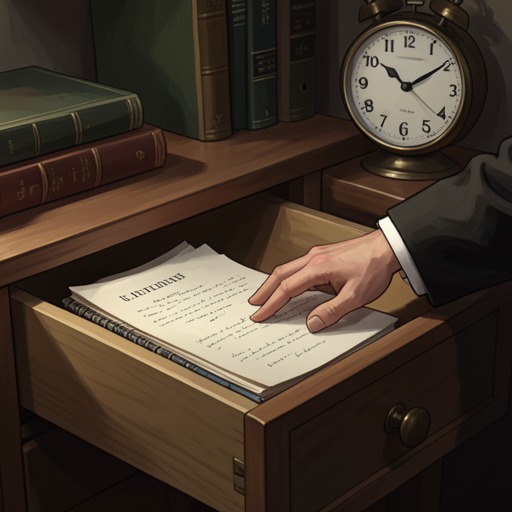
The deed is partially burned and pressed between the Bible’s Old and New Testaments, specifically between Malachi and Matthew. Devlin’s Bible has a battered cover, marked only by a small Canterbury cross stamped in gold. The placement makes the document physically inconspicuous, but its condition and position also give it the character of a fragment preserved rather than an ordinary instrument openly used in business.
Devlin understands the paper as both a receipt for a gift never given and a codicil to a will never made. Those descriptions do not establish that the document is legally effective; instead, they expose the uncertainty at its center. It records an intended transfer while pointing to the absence of the completed gift and of the will that might have given it force. Devlin knows it is valuable in some fashion but does not yet know its exact value.
Concealment and custody
After the burial of Crosbie Wells, a fortune of £4,000 is discovered in Wells’s cottage. The sum is exactly twice the amount named in the deed, placing the paper in direct relation to the newly uncovered wealth without making the two things identical. Devlin has hidden the deed between the pages of his Bible and, despite the discovery, continues to keep it secret.
In the Palace Hotel dining room, Devlin rests his hand protectively on the Bible. He does not yet know that the deed will be important to Balfour and other men, but he feels compelled to keep it close until he understands what it is worth. The gesture makes concealment an active choice: the document is not merely lost among his possessions but deliberately held back as evidence whose consequences remain unclear.
Intended disclosure and narrative significance
Devlin tells himself that he will show the paper to Anna once she is stronger and her near-suicide episode is behind her. For the moment, he judges it prudent to withhold the information. His intended disclosure ties the deed to Anna’s circumstances, while his delay leaves her without knowledge of a document that may bear on a gift. The evidence does not show that he ultimately gives it to her or that the paper settles a claim.
The deed’s importance is also signaled beyond Devlin’s immediate plans: the narrative anticipates its significance to Balfour and to other men, though Devlin himself does not yet understand why they will care. Its damaged state, ambiguous legal character, and concealed custody echo the wider struggle to establish who may claim wealth and what kinds of proof can support that claim. Unlike the gold itself, the deed does not resolve ownership by being found; it makes the question of ownership more consequential.